Types of service dogs, and what they're trained to do
A service dog is trained to do specific tasks for one person's disability. That's the legal test. A vest or a certificate doesn't make a dog a service dog. Daily K9 Academy coaches owner-trained teams for every type below. The only ones we don't train are guide dogs and hearing dogs.
- Psychiatric
- PTSD
- Autism
- Medical alert
- Medical response
- Mobility
- What does it cost?
- Which one do I need?
What makes a dog a service dog?
Under the ADA, the dog has to be trained to take a specific action tied to your disability. A dog whose presence comforts you is an emotional support animal, not a service dog. You're allowed to train your own dog, and no federal certification exists. Anyone selling one is selling paper.
Free checklist
Owner-trained service dog intake checklist
Ten things to have ready before an intake call: your tasks, your dog's profile, vet records, training time, budget, and the Arizona rules.
See our privacy policy for how your email is handled.
Your task list is built for you
The tasks below are examples, not a menu you have to pick from. We start with what your hardest days actually look like and train the tasks that change them. Most teams end up with a mix across categories - a PTSD dog that also braces on stairs, or a diabetic alert dog that also brings the phone.
Psychiatric service dogs
Where Nicole started, and the life she lives as a handler.
Who they help: people living with PTSD and trauma, panic and anxiety disorders, depression, bipolar disorder, OCD, dissociative disorders, and psychiatric symptoms after a brain injury.
Tasks we train, things like:
- Deep pressure during a panic attack or a flashback
- Interrupting a spiral, dissociation, skin picking, hair pulling or other repetitive behavior
- Grounding - a nudge, a lick, a paw to bring you back
- Blocking and crowd buffering in lines and busy places
- Room search and lights on before you walk in
- Nightmare interruption
- Medication and routine reminders - wake-up, meds, eat, go to bed
- Guided exit to a car, a door or a quiet spot
- Getting a person or bringing the phone in a crisis
- Alerting to rising anxiety before you notice it yourself
- Interrupting self-harm behaviors

More on this type: psychiatric service dog training in Phoenix and psychiatric service dog tasks.
PTSD and trauma service dogs
A PTSD dog is a psychiatric service dog trained around trauma. For veterans, first responders and survivors, the tasks that matter most tend to be blocking, room search, nightmare interruption, guided exit and grounding. Things like getting through a grocery store without scanning every aisle, or waking you before a nightmare takes the whole night.
Autism service dogs
For kids, the team is the dog, the child and a parent who handles the dog. For teens and adults, the person with autism can be the handler. There's no legal minimum age - a parent or another adult can handle the dog for a child. We start when your child walks steadily and is comfortable around the dog.
Tasks, things like:
- Behavior disruption when a meltdown starts
- Deep pressure during sensory overload
- Tracking a child who wanders off - scent work, and scent work is what Nicole does as a detection handler
- Tethering to keep a child from bolting
- Interrupting repetitive or self-injurious behavior
- Settling at bedtime
Medical alert dogs
Alert dogs pick up on changes in your body - usually scent, sometimes behavior - and tell you before you feel it. This is detection work, which is Nicole's other job. Some alerts can be trained reliably with samples from you. Others depend on a dog that already notices on its own. We'll tell you which is which for your condition, and an alert dog always works alongside your medical devices, never instead of them.
- Diabetes (low and high blood sugar) - trained on your breath or sweat samples. Some dogs get good at it. Studies also show misses and false alerts, so keep your glucose monitor.
- Adrenal insufficiency and cortisol changes - alerts to low cortisol so you take medication sooner. Promising, with very little research so far.
- POTS and heart rate or blood pressure drops - alerts you to sit or lie down before you faint, then responds.
- Migraine - some dogs change behavior before a migraine starts, so you can take medication early. Early research is based on owner reports.
- Narcolepsy and cataplexy - alerts before an episode where the dog shows it, and responds during one.
- Seizures - see response dogs below. Some dogs seem to sense a seizure coming, but the Epilepsy Foundation says that's rare and can't be reliably trained. We won't promise it.
- Allergen detection - searches food or rooms for a specific allergen like peanut or gluten. It's a tool on top of reading labels and carrying your epinephrine, not a replacement.
- Other conditions - if a body change comes before your symptoms, ask us. We'll assess honestly whether a dog can learn it.
Not sure which type fits you?
Book your free intake callMedical response dogs
Response dogs act during or after an episode. These tasks are very trainable.
- Seizure response - activate an alarm, get help, stay with you, help break a fall, position you after
- Fainting and falls - get help, bring the phone, brace you to stand
- Retrieve medication, water or a snack on cue or on schedule
- Wake you when an alarm isn't enough
- Find a specific person in the house and bring them to you
Mobility service dogs
For MS, Parkinson's, EDS, arthritis, spinal cord injury, balance disorders and other conditions that affect movement.
- Retrieve dropped items, the phone, keys
- Open and close doors, drawers, the fridge
- Turn lights on and off, push accessible door buttons
- Brace for balance, standing and stairs - only with a large enough dog that's full grown and vet-cleared for it
- Help you up after a fall
- Carry items, pull a laundry basket
- Help you get moving again when your walking freezes up (Parkinson's)
- Help remove shoes, socks or a jacket
Guide dogs and hearing dogs
We don't train guide dogs for blindness or hearing dogs for deafness. Both take a specialized program, and we'll point you to one.
Service dog vs emotional support animal vs therapy dog
| Service dog | Emotional support animal | Therapy dog | |
|---|---|---|---|
| What it does | Trained tasks for one person's disability | Comfort by being there | Visits people in hospitals, schools, care homes |
| Public access (stores, restaurants) | Yes, under the ADA | No | Only where invited |
| Housing | Yes | Yes, with a letter from a provider | No special rights |
| Training | Task training + public manners | None required | Temperament testing through a therapy dog group |
What does it cost?
Every type of service dog runs through the same program at the same rates. Your price is built from where your dog is starting and the number of tasks your team needs, not the type of dog. Most teams land around $4,000-$9,000 over 12-24 months, billed monthly. See published pricing.
How do I know which type I need?
Start with what your hardest days look like, not with the dog. On your free intake call we'll talk through the tasks that would change your day, whether your dog is a good candidate, and whether owner-training is right for you. If it isn't, we'll tell you and point you to a program that is.
Book your free intake call.
We'll talk through the tasks that would change your day and tell you honestly whether your dog is a prospect. Nicole replies within one business day. No cost, no pressure.
I work with a maximum of two active service dog teams at a time.
Book your free intake call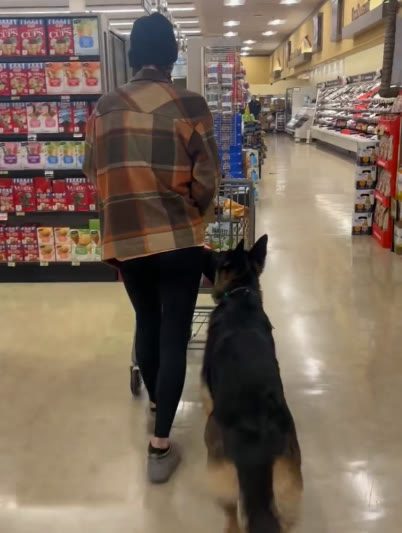
About the author
Nicole VanCleave is an ASCT Certified Instructor and the founder of Daily K9 Academy, coaching owner-trained service dog teams (psychiatric, autism, medical alert and response, and mobility) across Goodyear and greater Maricopa County, Arizona. She trained her own PSD, Bruce, a rehomed German Shepherd nobody selected for the work. Read her full background →
Sources
- U.S. Department of Justice, Frequently asked questions about service animals and the ADA.
- International Association of Assistance Dog Partners, Tasks performed by guide, hearing and service dogs.
- Disability Rights Arizona, Back to school for your child and her service animal.
- Epilepsy Foundation, Seizure dogs.
- Los, E. A. et al., Reliability of trained dogs to alert to hypoglycemia in patients with type 1 diabetes, Journal of Diabetes Science and Technology (2016).
- Society for Endocrinology, Cortisol alert dog: improving patient outcomes.
- Marcus, D. A. and Bhowmick, A., Survey of migraine sufferers with dogs to evaluate for canine migraine-alerting behaviors, Journal of Alternative and Complementary Medicine (2013).